Search This Blog

Sunday, February 22, 2015

"Too Big to Prosecute"


It looks like HSBC is at it again. In December 2012, the federal government decided against prosecuting HSBC Bank, the world’s second largest bank, against charges of money laundering for knownMexican cartel groups and terrorist groups including Al-Qaeda. Rather the bank was stuck with a $1.92 billion fine, approximately 5% of HSBC’s 2010-2011 profits (38 billion dollars), and an agreement from the United States Department of Justice to not prosecute the bank. The reasoning for this decision, the so called “Too Big to Prosecute” scandal, came from considerations of the bank’s massive power over the financial structure of the United States and United Kingdom. The following segment of a hearing before Senate Judiciary Committee between Eric Holder and Senator Chuck Grassley (R-Iowa) on February 27th, 2013, should show the Department of Justice’s motivations quite clearly:

Sen. Chuck Grassley, R-Iowa: In the case of bank prosecution. I'm concerned we have a mentality of 'too big to jail' in the financial sector, spreading from fraud cases to terrorist financing to money laundering cases. I would cite HSBC.
I think we are on a slippery slope and that's background for this question. I don't have recollection of DOJ prosecuting any high-profile financial criminal convictions in either companies or individuals.
(…)
Attorney General Eric Holder:
(…)
Just putting that aside for a minute though, the concern that you have raised is one that I, frankly, share. I'm not talking about HSBC here, that would be inappropriate. But I am concerned that the size of some of these institutions becomes so large that it does become difficult for us to prosecute them when we are hit with indications that if we do prosecute — if we do bring a criminal charge — it will have a negative impact on the national economy, perhaps even the world economy. I think that is a function of the fact that some of these institutions have become too large.
Again, I'm not talking about HSBC, this is more of a general comment. I think it has an inhibiting influence, impact on our ability to bring resolutions that I think would be more appropriate. I think that's something that we — you all [Congress] — need to consider. The concern that you raised is actually one that I share.“ (Full text can be found here)

This is admittedly a tricky issue, with the effects of prosecuting such a massive institution possibly causing shockwaves and consequences in nations non-culpable for the actions of HSBC. Yet the precedent set by non-persecution and a minimal fine allows for the creation of a sort of “this is the cost of doing business” mindset. It can be pretty easily agreed that the action of the United States Justice Department had very little deterrent effect on the actions of HSBC, especially assuming the profit gained by acting in an illegal manner offset any possible slap on the wrist.
                It appears that HSBC, again, has been found to be providing service to those with criminal affiliations and allowing certain clients to conceal funds for tax purposes from several European as well as the American government. France, Belgium, Spain and the US have all appeared to launch investigations against the bank. If this issue is as extensive as the previous one, we should expect a greater response from the Justice Department during this particular scandal, though the precedent will still likely be the same, that if you’re big and important enough, you’re above the law. Though this news story is still in its infancy, we shouldn’t expect an outcome much different than the prosecution effort in 2012.

                Unfortunately, this both puts the United States in a difficult position and appears to force them to make a choice. Allowing large and integrated enough corporations to act in an illegal manners will most certainly ensure that they will. After all, often times the most profitable position often isn’t the legal one, and not grasping at an advantage can result in a competitor taking such an advantage for themselves. Yet prosecution can result in widespread systemic changes to the financial infrastructure of Western nations, and in an economic climate with rising stars like China and India, such a decision can be what leads to a loss of economic dominance in the West. I don’t pretend to know what the appropriate way to act in such a situation may be, but it seems to be a pretty safe bet if we don’t hold corporations liable for infractions of the law, these legal infractions will continue to occur where profitable. Most importantly, we have to ask what sort of message this send to large companies, after all, what sort of power does an enforcement agency have when it can no longer enforce?

Saturday, February 14, 2015

Are antiviral cocktails increasing the virulence of HIV?


I came across an article published by ScienceDaily about a new, highly virulent recombinant HIV virus that seems to be able to go from initial infection to AIDS in a matter of only three years, as opposed to the average of ten (assuming no treatment). Although this isn't the first time an extra virulent HIV strain has been found (this strain leading to the development of AIDS in only five years) such a small window of time seems to produce serious issues with detection in infected individuals.
        A study published by Ndawinz et al. in 2001 seems to suggest an estimated mean infection to diagnosis time of 53 months for heterosexual males and 37 months for homosexual males in a sample of men in France. Although it is unlikely that such a study is entirely generalization to the populations of other developed countries, there's no reason to believe a significant variance in times from infection to diagnosis in these areas. As such, this strain seems to be able to cause significant increases in viral load before any sort of detection can occur, allowing uncontrolled spread before the infection can be treated.
The reasons for such a strain evolving is unclear, and it may simply be a random mutation that will be out of the headlines permanently in the next few weeks (as was the fate of the 'five year strain' above). It's hard to be sure, though it has been suggested that HIV may be getting more virulent throughout since its initial outbreak 30 years ago. The selective pressure that pushes for the increased virulence of HIV is a result of a plethora of factors, though the driving force is likely the widespread use of drug cocktails for treatment of infections in developed countries. Increases in viral load (concentration of HIV virus in blood) lead to increased probability of infection from a host to a sexual partner in any one sexual encounter. After treatment with a antiviral cocktail, viral load in infected individuals drops significantly, and as a result, so does infectivity, an incredibly unfavorable outcome for the virus.
Larger spikes in viral load over a shorter amount of time seem to counteract this effect if such a spike occurs before detection and administration of antiviral drugs. Such a significant spike in virulence naturally leads to more infections in less time, and as a side effect of the pronounced increase in virulence, more deaths.
The above speculation should not be taken as fact, as a study by Oxford University as well as one released by Nature seem to suggest there is a lot more to the story, with reduced virulence seen over time by the Oxford study as a result of antiviral drug cocktails.
The Nature study, on the other hand, seems to suggest a 'bottleneck' after each moment of person to person spread, where the virus must evolve to be better suited for the new hosts immune system leading to reduced overall fitness for the beginning stages of infection. It is also suggested by the study that less virulent infections may very well result in a higher spread of HIV virus, as a longer living host may have more opportunities to spread the virus. The relevant quote is found below:

" Increased transmission efficiency is associated with higher viral loads, which are highest during acute infection. However, the short time interval of acute infection provides limited opportunity for transmission. As the disease progresses and viral load increases, the efficiency of transmission will increase even though opportunities for transmission can remain constant. Consequently, more transmission events might result from prolonged, compared with rapid, disease progression ... even when accounting for the high transmission efficiencies during acute infection149, 150. In this model, owing to the fitness bottlenecks at transmission and the subsequent loss in fitness caused by CTL escape111, 112, 113, the circulating HIV-1 isolate will start to lose virulence. This loss in virulence would decrease pathogenesis, prolong the time to AIDS or even result in a non-symptomatic infection. The complete clearance of HIV-1 is unlikely because of the stable integration of the provirus into memory T cells with long half lives and possible re-activation of virus replication in these cells"

With widespread use of antiviral cocktails in more developed nations, it seems the benefit of the weaker, longer infection is strongly countered. The virus is forced to either develop resistance to the drug cocktail, or infect as many potential hosts as possible in the period pre-diagnosis. The suggestion that a longer term infection can lead to more opportunities for infection seems to be a difficult one to accept, especially when strains are beginning to emerge that can more strongly counter the early infection bottleneck.

So is HIV getting more virulent over time? It's a very difficult question to form a definitive opinion on, and lots of contradictory research exists on the topic. There seems to be pressures for increased virulence in areas with greater access to antiviral drugs, while countries with poor health infrastructure seem to favor a more mild virus with a longer progression. The virulence pattern of HIV will prove to be an important consideration in the future, and as the sixth largest killer of humans overall, it is a truly important consideration in the fight against human disease globally.


Above image from the following article: http://www.dddmag.com/news/2014/08/protein-family-can-inhibit-hiv-release

Sunday, February 8, 2015

Perceptions of Violence


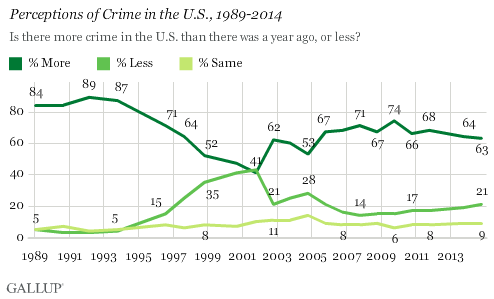
Thanks to our media, the perception of increasing violent crime seems to be shared by the majority of Americans, a view strongly at odds with the reality of both the national and global stage. An annual Gallup poll asking Americans if they viewed crime as increasing, decreasing or staying the same seems to indicate a rising perception of crime increasing from 2002 and on, despite the fact that violent victimization rates have dropped from 80 people per 100,000 in 1993 to 23 in 100,000 in 2013, a rate almost a quarter of its 2013 value. Interestingly enough, perceptions of crime increasing locally have dropped slightly since the previous polling year (2012) but have remained within the mean since 1972, pointing at non-local new sources skewing our opinions of violent crime within the past 15 years.
                This shouldn’t be particularly surprising to anyone, there exists few better ways to sell a headline than to make someone feel their individual safety or way of life is in peril. Ebola is an interesting example of this phenomena, bearing a host of symptoms like bleeding into the skin and gums, multiple organ failure and decreased blood clotting. Few things are as viscerally abhorrent as a death from such a horrific virus.  Yet lower respiratory infections, malaria and diarrheal diseases making up the largest chunk of microbial deaths in the African continent. You have to give some serious credit to the Bill and Melinda Gates Foundation for their development of the Omniproccessor , a machine that turns liquid waste into electricity and drinking water, and the tremendous effect to diminish malaria related deaths through the foundation. These massive killers, much more serious threats to impoverished citizens in Africa, have no bearing on the quality of our lives and no perceived risk of causing harm to the average citizen of the developed world. Malaria isn’t some boogeyman that causes uncontrolled bleeding and a violent, gory death, it’s an uncomfortable and tired demise.
This coupling of news with entertainment leads to a disconnect between how viewers see the world and how it actually is, with “sexier” topics taking the bulk of news coverage. News providers need to cover their expenses, and greater viewership means more ad revenue. This has the unfortunate consequence of shifting more ill-advised viewers to a view of the world that is much more violent, angry, and fitting of a dualistic good vs. evil motif than it actually is. The viewpoint is echoed by a Dr. Mark Warr, a sociologist at UT Austin:

“ “Many people don’t realize that while reported crime may appear to go up in a given year, that doesn’t mean real crime rates are on the rise,” Warr says. “Based on data from a variety of measurement tools, the overall trend is actually quite good. In fact, the homicide rate in the western world has actually been declining for more than 700 years.”

Yet when dramas such as “CSI,” “Criminal Minds” and “Law & Order” dominate popular television, and crime coverage often fills a quarter of newspapers, measured perspectives such as Warr’s are often lost in the clamor for lurid stories about America’s most wanted.
As a result, the messages about crime that people receive from the mass media are often out of sync with reality, Warr contends.
“People are bombarded with information about crime from the media, which makes them believe the world is a much more dangerous place than it really is,” Warr says. “This creates a climate of fear that can negatively affect the way we live, the way we go to work, the times we shop and the precautions we take for our families and children.” ”

The effects such views can have on Public Policy formation should be strongly considered by the public at large. The relative risk violent crime contributes to our everyday experience, or even our lives as a whole, is minimal. With so many other major causes of death like Diarrhoeal disease (death being preventable by simply hydrating affected individuals during the duration of their illness) and motor accidents still making the top ten list of killers globally, policy should be pushed much further in those directions if human mortality is really the goal driving policy. 

Saturday, January 31, 2015

The Public Intellectual- A Case Study

                Before beginning this blog I’d like to examine what it means to be a ‘Public Intellectual’, after all, these individuals make up some of the largest followings in the Blogosphere. Though I do not claim to be one myself, I feel they represent an ideal of analytic ability that all bloggers should aspire for. In particular, I’d like to do a sort of 'case study' of Bill Moyers, a man whose analysis of class differences and poverty I found to be done quite rigorously. Before this analysis though, we should ask what it means to be defined as a public intellectual.

What gives a public intellectual their exclusive status is their ability to provide a unique, well-founded perspective on a particular set of issues. Such a perspective is often very well supported and if done correctly, difficult to refute. The viewpoints we often see people ‘parroting’ are often originally generated by those in the realm of the media, especially among strong nodes of political perspective (for example, Fox News and MSNBC) and can often result in a homogenization of views across party lines. This is why it is important for us to really examine what sorts of people we let effect our views, after all, they often set the stage for the public rhetoric. What distinguishes the public intellectual from the typical ‘talking head’ types is worth strong consideration.

In my view, what gives one an ability to articulate strongly supported perspectives come primarily from three sources: a strong educational background, political experience or direct experience (as relating to the issues you are analyzing). Of these, an individual often contributes different things based on which of the three of the above are hit. These three allow access to different perspectives of an issue, with an education allowing for analysis and historical perspectives, while not contributing any sort of phenomenological tie to the issues at hand.
This also poses a serious issue for the political types and was central to the criticisms pushed at Mitt Romney during the 2012 Presidential Elections. An inability to connect to the public at large creates a perception of separation between the political class and the everyday citizen, one that scream: “our representative neither care nor understand us”.

The expansion of this topic is vitally important for this post, as direct experience is the position that Bill Moyers is most lacking in, while yielding a very strong educational and political resume. Direct experience allows readers to feel connected and understood by the speaker, letting them know that they understand, they have been in your shoes. With the wide variety of new sources available via the web, choosing who to let inform your information flow often comes from identification with the source or the issues they present.
 I’m aware of this bias in myself, and growing up in a very low income family naturally pulls my attention to issues of the large financial gap between the well off and the impoverished. Finding a writer that shares this experience with me often pulls my attention, though this should not be the sticking point. Having such a perspective yields valuable data into one’s opinion, one that cannot be replicated via schooling or political experience, yet such a perspective should only work to make one’s argument even more potent, supplying perspectives that may not considered by those who are not tied to an issue personally.

Though Moyers does not appear to have any sort of personal ties to poverty, I find his analysis to be particularly formidable on the issues of financial differences between the upper and lower economic classes, a topic of constant consideration for Moyers, with Economic Inequality being one of the premiere subheadings of his website. His impressive power of analysis can be tied to Moyer’s strong representation journalistically (I know, it's not a word).

Moyers received a bachelors in Journalism and Masters in Divinity and held positions as White House Press Secretaries for Lyndon B. Johnson as well as a Peace Corp Deputy Director under the Kennedy administration, giving him distinct perspectives on issues of the economic and political sort.  The majority of his public career was a result of Moyers work in journalism (rather than his study of it), working for Newsday before taking a role working for PBS. Having worked in journalism since the late 60’s, Bill Moyers continued relevance points towards his ability to provide compelling criticism despite the changing global climate of our time, something more than likely refined by his long time presence in the public eye (you can find more on Bill Moyers here)

The central role criticism plays in identification as a public intellectual is explained quite comprehensively by Stephen Mack, a Professor at the University of Southern California, in his blog:


“... the public intellectual function is criticism. And if intellectuals are in a better position to perform that function it’s not because they are uniquely blessed with wisdom—and it’s certainly not because they are uniquely equipped to wield social or political power. It is only because learning the processes of criticism and practicing them with some regularity are requisites for intellectual employment. It’s what we do at our day jobs.

It is also, however, the obligation of every citizen in a democracy. Trained to it or not, all participants in self-government are duty-bound to prod, poke, and pester the powerful institutions that would shape their lives. And so if public intellectuals have any role to play in a democracy—and they do—it’s simply to keep the pot boiling. The measure of public intellectual work is not whether the people are listening, but whether they’re hearing things worth talking about.”


       Mack’s second paragraph bridges the relationship between the public and the intellectual in an important way, giving us a hint as to why Moyers continues to pique our interest today. His continued analysis still bares relevance. With poverty being an omnipresent part of our American reality (roughly 15% of Americans are below the poverty line) and the idea of the shrinking middle class relatability to most of those above it, his ideas appear to strike a chord with most Americans. Of course, Moyers importance as a journalist does not come from his following (that would contradict the quote above), but rather his extensive experience with analysis and his development of the tools that allow him to criticize via his long career as an analyst.
                The real test of a public intellectual should not lie in credential, but rather the ability such credentials allow them to inform a view that is both ‘on point’ and, as mentioned above, difficult to refute. Despite the obligation Mack describes above, very few Americans take this responsibility seriously, giving the public intellectual an unusual degree of power in public opinion. Whether intended or not, the public intellectual’s sway in the opinion of others should be carefully considered, and attempts to inform opinion for shock value and clicks will only serve to result in the downfall of the American political rhetoric.
                This is another place that I find Moyer’s to be quite refreshing, as pointed out by his Biography by the New York Times, he is quite well known for interviewing polarizing figures of the time, with such notable interviews as Salman Rushdie, Maya Angelou and Ronald Regan. This of course, speaks very little of his ability to approach these important individuals with any sort of minimal bias, so I challenge the reader to watch this interview of Kelsey Juliana by Bill Moyers.
               
       As you can see, this distinctive sort of interview style, what I would like to call ‘supporting the interviewee’ is at odds with the Fox Newseque ‘leading the interviewee’ style often used by figures like Sean Hannity and Bill Maher. This allows the interviewee to fully express their views, as they see them, to the audience, rather than being lead to support one position or another without being cut off.  

Admittedly, it is difficult to fully encompass a 50+ year career in a single blog post and that is not the intention of this article. Rather, we must understand the role the public intellectual plays in our everyday lives and take this degree of responsibility they yield seriously. Though journalistic websites like billmoyers.com bare a respectable backing, it is nothing compared to the backing of sites like Gawker, which has a celebrity sighting tracker (aptly called the Gawker Stalker) and Huffington Post (famous for its overuse of the X WAYS YOU CAN Y, which was later beat into the ground by Buzzfeed). 
Though these blogs can bear the occasional political insight, their obsession with clicks and views threatens to water down any journalistic integrity to a popularity contest. This was all too obvious during the Deflategate 'scandal', a situation that did not deserve the exposure that it was granted. It is important we as politically active citizens use the public intellectual as another opinion to consider, rather than the tell all be all end all of political opinion. But in this ever present reality of style over substance, it is the role of the public intellectual to remain steadfast and true to a standard of journalistic integrity. This I feel, Bill Moyers strongly epitomizes, and this is why I've chosen to write about him. Give him a look, you may not agree with him, but I can guarantee you'll find his views quite informed.